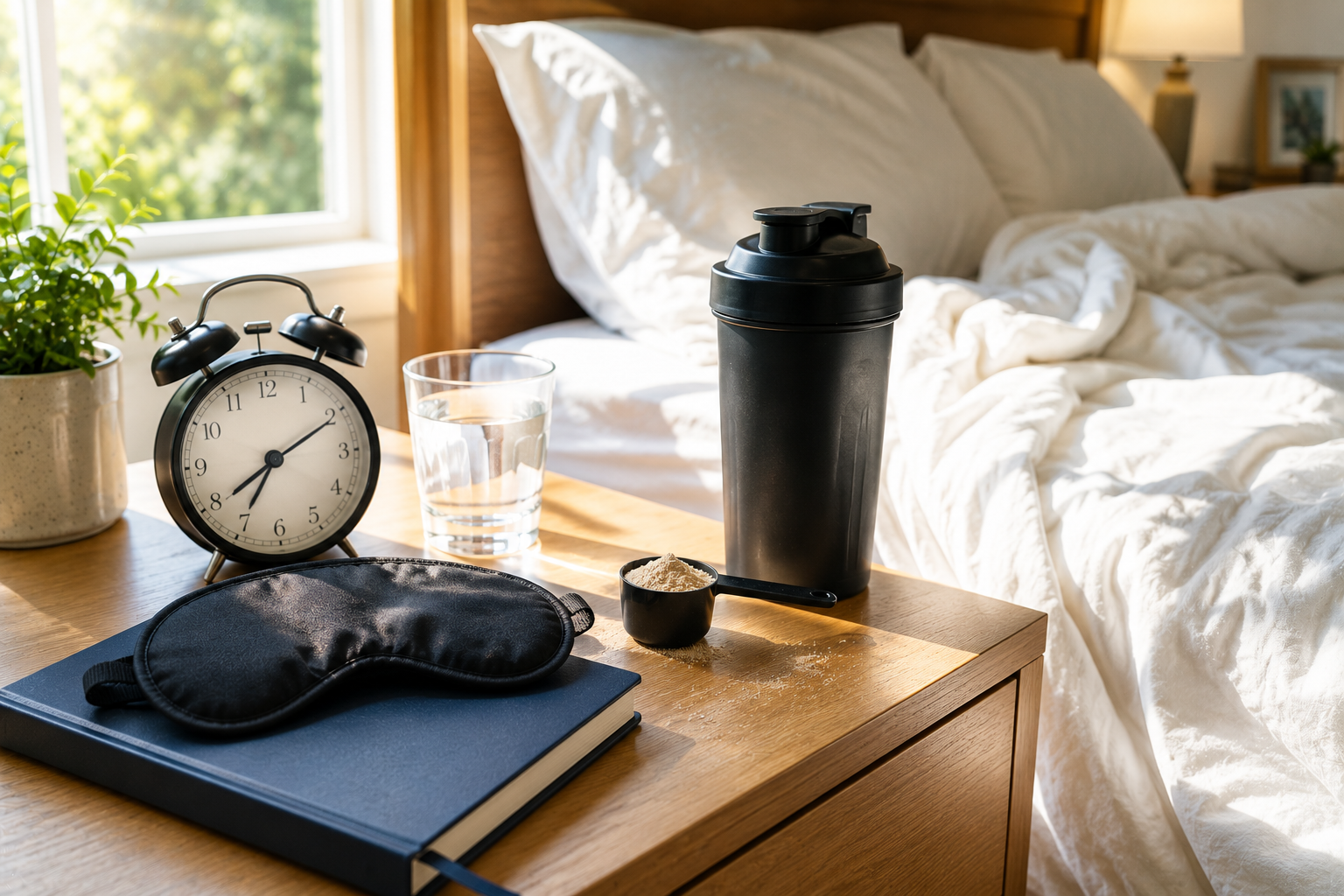
Sleep Is the Supplement You're Not Taking Seriously: What Happens to Muscle and Fat When You're Underslept
Are You Training Hard but Sleeping Too Little?
Are you dedicating hours to training and meal prep while neglecting sleep?
If so, you may be making your fitness goals harder than they need to be.
In fitness, training and nutrition tend to receive most of the attention. Sleep, by comparison, is often treated as something that happens after the important work is finished.
But sleep is part of the work.
Your body needs adequate sleep to recover from training, regulate appetite, support physical performance, and maintain healthy metabolic function. When sleep consistently falls short, the effects can extend well beyond feeling tired the next morning.
Why This Matters Now
Modern schedules make sleep easy to sacrifice. Work, social obligations, screen time, family responsibilities, and even additional training can all compete with the hours available for rest.
For people pursuing fitness goals, that creates an obvious problem: the same person who is trying to optimize training and nutrition may be undermining both by consistently cutting sleep short.
Research increasingly shows that inadequate sleep can affect physical performance, recovery, eating behavior, and body composition.
The question, therefore, isn't simply how much you train or what you eat.
It's also whether you're giving your body enough opportunity to adapt to those efforts.
Shawn Stevenson: Recovery Happens While You Sleep
Sleep scientist and author Shawn Stevenson emphasizes the importance of sleep for recovery and adaptation.
Training creates a physical stimulus. Recovery is what allows the body to respond to that stimulus.
When sleep is consistently inadequate, the recovery process can be compromised. Fatigue can accumulate, performance can decline, and the ability to maintain a demanding training schedule can suffer.
This matters particularly for people trying to build muscle.
You don't build muscle simply by completing another workout. You build it by recovering from the training stimulus and adapting to it.
Sleep is an important component of that process.
Stevenson also points to hormonal changes associated with insufficient sleep, arguing that chronic sleep loss can create an environment less favorable to recovery and body-composition goals.
The practical takeaway is straightforward: more training isn't automatically better if you're not recovering from it.
Dr. Christopher Winter: Sleep Changes How You Eat
Dr. Christopher Winter focuses on another important consequence of sleep deprivation: decision-making.
When you're exhausted, maintaining the same level of discipline around food can become more difficult. Fatigue can make convenient, highly palatable foods more appealing and can make meal planning feel like an unnecessary burden.
This creates a cycle:
Less sleep → greater fatigue → poorer food decisions → harder-to-manage nutrition.
Sleep deprivation can also make workouts feel more difficult. You may have less energy, reduced motivation, or simply decide that skipping a session is easier than pushing through another exhausting day.
Over time, these small decisions can accumulate.
This is why sleep shouldn't be viewed solely as a recovery tool. It can also influence the behaviors that determine whether your nutrition and training plan is sustainable.
Dr. Michael Breus: Sleep and Metabolic Health
Dr. Michael Breus expands the discussion to metabolism and energy regulation.
Insufficient sleep has been associated with changes in metabolic function, including impaired insulin sensitivity and alterations in appetite regulation.
For someone attempting to lose fat, this matters because successful fat loss requires more than simply creating a calorie deficit once or twice.
It requires maintaining the behaviors that support that deficit over time.
Poor sleep can make that process harder by increasing hunger, intensifying cravings, reducing training performance, and making adherence more difficult.
Sleep does not magically cause fat loss—but inadequate sleep can make the entire process harder.
That distinction is important.
What Happens When You're Underslept?
The effects aren't necessarily isolated to one part of your fitness program.
When sleep is consistently inadequate, several things can happen at once:
- Recovery can suffer, making it harder to bounce back between workouts.
- Training performance can decline, reducing the quality of your sessions.
- Appetite and cravings can change, making nutrition more difficult to manage.
- Food choices can become less consistent, particularly when fatigue is high.
- Metabolic regulation can be affected, potentially complicating body-composition goals.
- Consistency can deteriorate, because exhaustion makes both training and meal preparation harder to maintain.
The result is a frustrating scenario: you're putting effort into the gym and kitchen while one of the foundations underneath both is being neglected.
Editorial Synthesis
Where Experts Agree
The perspectives converge on several key points.
Sleep supports recovery. Training creates stress, and adequate recovery is necessary for adaptation.
Sleep affects behavior. Being tired can influence food choices, motivation, and the ability to maintain a consistent routine.
Sleep and metabolism are connected. Insufficient sleep can affect appetite regulation and metabolic processes relevant to body composition.
Where Experts Disagree
The biggest differences concern how much sleep an individual needs and how sleep should be prioritized relative to other lifestyle factors.
There is no single number that guarantees optimal recovery for every person. Individual needs can vary depending on factors such as training load, stress, health, and lifestyle.
The broader principle is more useful than obsessing over a specific number:
If you're consistently exhausted, your recovery strategy probably needs attention.
Why This Matters
It's easy to think of fitness as a simple equation:
Train harder + eat better = better results.
But the equation is incomplete.
Training provides the stimulus. Nutrition provides resources. Sleep provides a major part of the recovery environment in which your body adapts.
That means sacrificing sleep to squeeze in another workout isn't necessarily productive. In some cases, the better decision may be to prioritize recovery so that your next training session is more effective.
Likewise, spending hours preparing the perfect diet matters less if exhaustion repeatedly causes you to abandon it.
Sleep isn't a magic supplement, and getting more of it won't compensate for poor training or nutrition.
But consistently neglecting it can undermine both.
The most effective fitness routine is therefore not necessarily the one that demands the most from you every day. It's the one that allows you to train, eat, recover, and repeat those behaviors consistently.