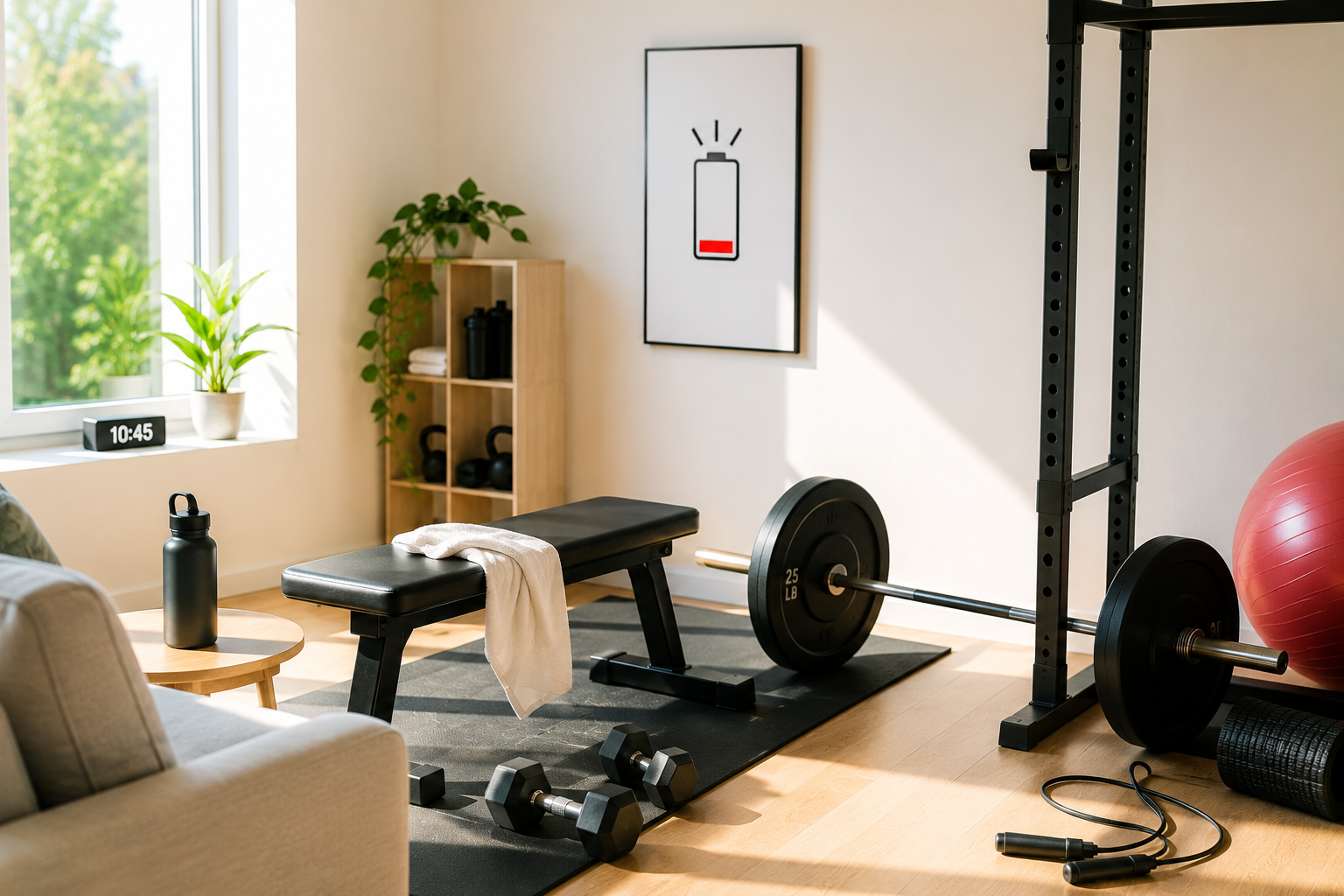
The home gym has an obvious selling point: the gym is always open.
No commute.
No waiting for equipment.
No membership fee after the initial investment.
No crowded locker room.
No need to coordinate your schedule around opening hours.
Yet there is an uncomfortable paradox.
The easier exercise becomes to access, the easier it can become to postpone.
A barbell sitting three feet away doesn't create the same psychological commitment as driving to a gym, meeting a training partner, or attending a scheduled class.
So the important question isn't whether home equipment can produce results.
It can.
The question is whether the environment makes it sufficiently easy to use that equipment consistently.
The Pandemic Changed the Experiment
The pandemic turned millions of homes into temporary gyms.
People bought dumbbells, treadmills, bikes, resistance bands, benches, racks, and connected fitness equipment.
The initial logic was compelling: remove friction and adherence should increase.
But the experience revealed something more complicated.
There are at least two different forms of friction:
Access friction: getting to the gym, finding parking, waiting for equipment.
Behavioral friction: stopping what you're doing, changing into workout clothes, starting the session, resisting distractions, and actually following through.
A home gym almost completely eliminates the first.
It doesn't necessarily eliminate the second.
Sometimes it makes it worse.
Convenience Is Powerful—But Ambiguous
Imagine two people who both own an excellent home gym.
Person A finishes work at 6 p.m., changes clothes, walks into the training area, and starts a programmed workout.
Person B finishes work at 6 p.m., sees the same equipment, answers a few messages, makes dinner, watches something, and tells themselves they'll train later.
The equipment is identical.
The outcome isn't.
That's because equipment is an enabling resource, not a behavioral guarantee.
This is one of the strongest arguments for home gyms: when the environment and routine are designed correctly, convenience can make consistent exercise dramatically easier.
But convenience without structure can simply make procrastination more convenient.
The Gym Provides Invisible Accountability
Commercial gyms provide several behavioral cues that are easy to overlook.
You see other people exercising.
You may have a trainer waiting.
You may have a class beginning at a specific time.
You drove there specifically to train.
Your workout clothes are already on.
The environment itself communicates:
This is where exercise happens.
At home, the same room might also be:
- an office;
- a living room;
- a place to watch television;
- a place to eat;
- a place to handle household tasks.
The brain receives competing signals.
That's why a dedicated training area can matter even when it contains relatively little equipment.
The physical space becomes a cue.
More Equipment Isn't Necessarily Better
One of the stranger mistakes people make with home gyms is accumulating equipment instead of building a training system.
A room containing:
- adjustable dumbbells;
- a rack;
- a bench;
- a cable machine;
- a treadmill;
- a bike;
- resistance bands;
- kettlebells;
- specialty bars;
may look impressive.
But if the owner doesn't know what to do when they walk into the room, the equipment has limited value.
The better approach is almost the opposite.
Reduce decision-making.
Know:
- what you're training;
- which exercises you're performing;
- how many sets;
- how much weight;
- how you're progressing;
- when you're training again.
A simple program performed consistently beats an impressive equipment collection used randomly.
The Social Question
This is where home gyms genuinely lose an advantage for some people.
Exercise isn't purely mechanical.
For many people, social reinforcement is part of the motivation.
A training partner creates accountability.
A coach provides feedback.
A class creates commitment.
Even seeing other people train can reinforce the behavior.
Home training removes much of this by default.
But it doesn't have to remove accountability altogether.
You can recreate some of it through:
- an online coach;
- scheduled virtual classes;
- a training partner;
- shared workout logs;
- regular progress reviews;
- group challenges;
- a fixed appointment with yourself that you treat as non-negotiable.
The important principle is simple:
If the environment doesn't provide accountability, the routine has to provide it.
The Home Environment Can Work Against You
There is another problem that commercial gyms don't have to the same extent: household interruptions.
At home, the workout competes with everything else.
Laundry.
Children.
Work emails.
Delivery notifications.
Cooking.
Pets.
Television.
Household chores.
The psychological boundary between "training time" and "normal life" can disappear.
That's why even a small dedicated area can be useful.
The goal isn't necessarily to build a magazine-worthy home gym.
It's to create a physical and psychological boundary:
When I'm here, I train.
The Strongest Case for Home Gyms
For the right person, a home gym can actually be superior to a commercial gym.
Consider someone who:
- dislikes crowded gyms;
- has a predictable schedule;
- prefers training alone;
- already knows how to program workouts;
- has limited commuting time;
- enjoys strength training;
- values privacy;
- can establish consistent routines.
For that person, removing travel and waiting time can be a major advantage.
A 60-minute workout doesn't require 90 minutes or two hours of total time.
And that matters.
The less logistical effort required to exercise, the easier it can be to maintain the habit.
The Strongest Case Against Home Gyms
The opposite personality can struggle.
If someone:
- needs external accountability;
- enjoys group classes;
- lacks training knowledge;
- frequently changes schedules;
- is easily distracted at home;
- doesn't have dedicated space;
- relies heavily on social motivation;
then buying equipment may solve the wrong problem.
They don't necessarily need more equipment.
They need more structure.
A gym membership, trainer, class, or training partner may therefore be more effective—even if the home gym appears more convenient on paper.
Editorial Synthesis
Where the Argument Is Strong
- Home gyms can dramatically reduce logistical barriers to exercise.
- Equipment alone does not guarantee adherence.
- Environment and routine strongly influence behavior.
- Structured programming can prevent the "too many choices" problem.
- Accountability can be recreated through partners, coaches, classes, or tracking systems.
- A dedicated training space can function as a behavioral cue.
Where the Argument Needs Nuance
The claim that home gyms inherently lack motivation is too broad.
For some people, the absence of other people is precisely what makes home training sustainable.
Likewise, social interaction isn't universally beneficial. Some people find crowded gyms distracting or uncomfortable.
The optimal environment is therefore highly individual.
The relevant question isn't:
"Is a home gym better than a commercial gym?"
It's:
"Which environment makes this particular person most likely to train consistently?"
Why This Matters
Fitness equipment is often marketed as though purchasing the right object is the difficult part.
It isn't.
The difficult part is turning intention into repeated behavior.
A $5,000 home gym used twice a month is an expensive storage system.
A pair of dumbbells used four times a week can be an effective training facility.
That distinction explains why the most important investment isn't necessarily the equipment.
It is the system surrounding the equipment.
Set a schedule.
Keep the program simple.
Make the training space easy to enter.
Remove distractions.
Track progression.
Create accountability if you need it.
And most importantly, make the default behavior starting the workout, rather than deciding every day whether you're going to exercise.
A home gym isn't effective because it's in your house.
It's effective when your house has become a place where training reliably happens.