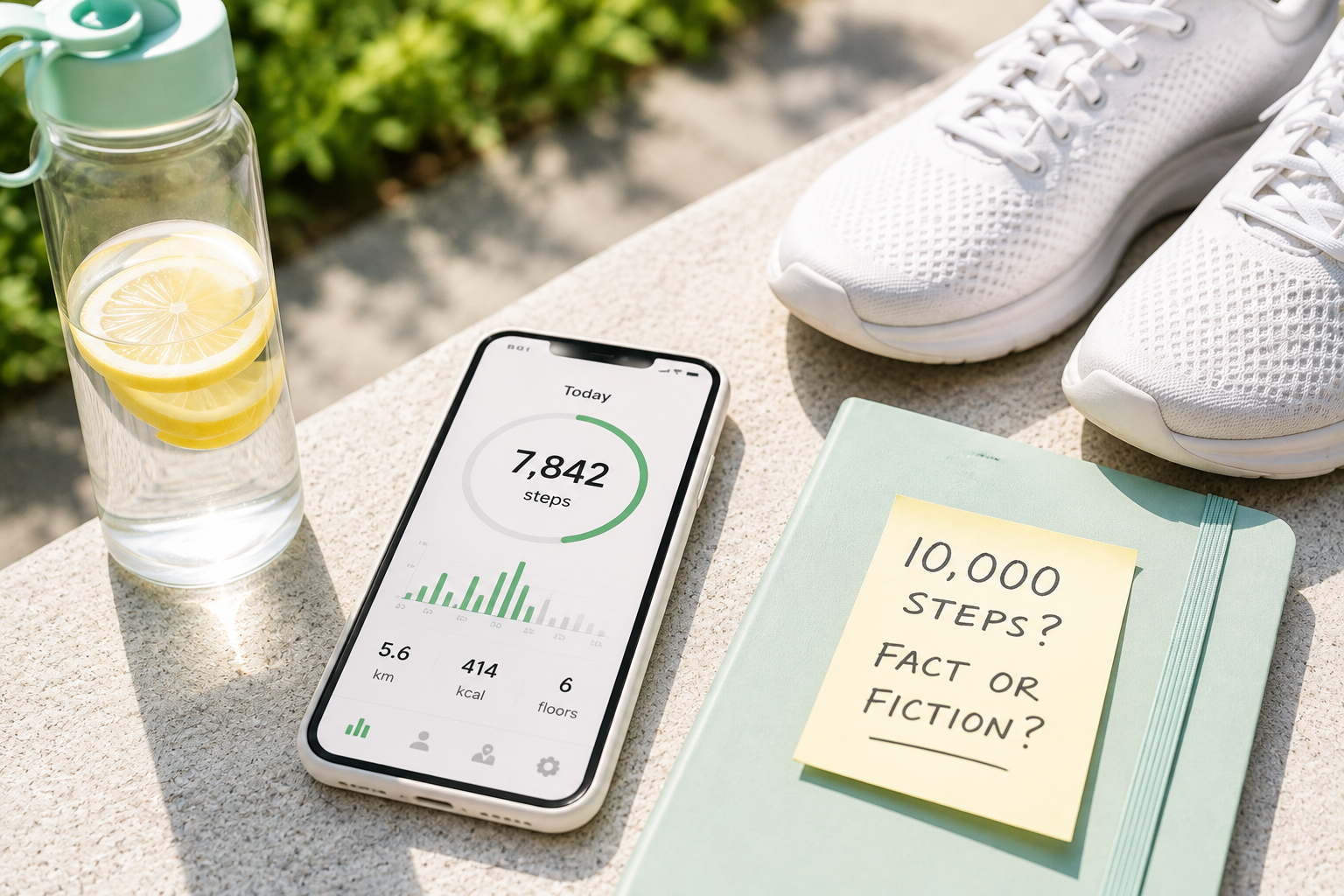
The Step Count Debate: Is 10,000 Steps a Day Science or Marketing?
For years, the message has been remarkably simple:
Walk 10,000 steps a day.
It's on watches.
It's on phones.
It's printed in fitness programs.
It's become almost synonymous with being "active."
But there's a problem with treating 10,000 as a biological threshold.
There isn't a switch inside the human body that flips at step 10,000.
The number became popular partly because of a Japanese pedometer marketed in the 1960s as the Manpo-kei, or "10,000 steps meter." In other words, the famous target had a marketing history before it had the scientific status many people now assume it possesses. (JAMA Network)
That doesn't make 10,000 steps useless.
It makes the number a target rather than a law of human physiology.
The Important Part Is the Curve, Not the Number
Research has repeatedly suggested that increasing activity is associated with better health outcomes, but the relationship isn't necessarily:
9,999 steps = insufficient
10,000 steps = healthy
One influential study of older women found that mortality rates were already lower at roughly 4,400 steps per day compared with about 2,700, with benefits continuing to increase before leveling off around 7,500 steps. (JAMA Network)
That tells us something important.
You don't need to reach an arbitrary finish line before movement starts paying dividends.
If someone currently walks 3,000 steps a day and consistently moves toward 5,000, that's meaningful progress.
If someone reaches 7,000 and doesn't want to chase 10,000, that doesn't mean the previous movement suddenly stops counting.
The Marketing Number Became a Psychological Tool
There's actually a strong argument for keeping 10,000.
People like simple goals.
"Move more" is scientifically reasonable but psychologically vague.
"Reach 10,000 steps" is measurable.
You know whether you did it.
You can see progress.
You can compete against yesterday's number.
And you can turn an abstract health recommendation into something concrete.
That's valuable.
The mistake is confusing a useful behavioral target with a universal medical requirement.
A number can be arbitrary in origin and still useful in practice.
What 10,000 Steps Doesn't Measure
Step counters have another limitation: they measure one form of movement.
Consider two people.
Person A walks 10,000 easy steps.
Person B walks 6,000 steps, spends 30 minutes cycling, and performs two strength sessions during the week.
Who is "more fit"?
The step counter can't answer that question.
And current U.S. physical-activity guidance doesn't prescribe a daily step count. For adults, the CDC recommends at least 150 minutes of moderate-intensity aerobic activity per week, or an equivalent amount of vigorous activity, plus muscle-strengthening activity on at least two days per week. (CDC)
That's a much broader definition of physical activity.
Steps Are Great for One Thing: Making Movement Visible
One of the greatest benefits of step tracking isn't necessarily the number itself.
It's awareness.
Without a tracker, someone might think they're reasonably active because they exercise three times a week.
Then they discover that they spend the other 14 hours they're awake mostly sitting.
The step counter exposes the difference between:
"I exercise."
and
"I move regularly throughout the day."
Those aren't necessarily the same thing.
Walking is also relatively accessible. It doesn't require a gym membership, specialized equipment, or advanced technical knowledge.
For many people, increasing ordinary movement is therefore an easier starting point than designing an elaborate exercise program.
But Don't Let the Counter Become the Coach
There is a psychological downside to turning steps into a score.
Once the number becomes the goal, people can start optimizing the number instead of the underlying behavior.
A person may pace around the house at night simply to make the watch say 10,000.
Meanwhile, they may neglect:
- strength training;
- cardiovascular conditioning;
- mobility;
- sleep;
- recovery;
- enjoyable forms of exercise.
The metric has replaced the objective.
That's a classic measurement problem:
When the measurement becomes the goal, people start optimizing the measurement.
The Better Question: More Than Yesterday?
For someone who currently averages 3,000 steps, the most useful target may not be 10,000.
It might be 4,000.
Then 5,000.
Then perhaps 6,000.
The exact progression depends on the person, their lifestyle, and their physical capabilities.
The CDC's current guidance makes the broader principle explicit: some physical activity is better than none, and people who cannot meet the standard recommendations should still be as active as their circumstances allow. (CDC)
That is a considerably more useful message than making people feel as though 9,000 steps represents failure.
What About Older Adults and People With Limitations?
This is where the obsession with one universal number becomes particularly problematic.
A healthy 25-year-old marathon trainee and a 75-year-old sedentary person shouldn't necessarily have the same movement target.
Neither should someone with a condition that affects mobility.
For older adults, the CDC recommends combining aerobic activity with muscle strengthening and balance activities—not simply maximizing steps. (CDC)
The same principle applies to people with chronic conditions or disabilities: activity should be adapted to individual abilities, rather than treated as a pass/fail contest against an arbitrary number. (CDC)
So, Is 10,000 Steps Science or Marketing?
Both—but in different ways.
The 10,000 is not a scientifically established threshold that everyone must reach.
Its origin is strongly associated with the marketing of a Japanese pedometer in the 1960s. (JAMA Network)
But the underlying idea—that regularly moving more is generally beneficial—is supported by a much broader body of evidence and public-health guidance. (CDC)
So dismissing 10,000 steps as "just marketing" goes too far.
The better conclusion is:
The number is marketing. The movement isn't.
Editorial Synthesis
Where the Argument Is Strong
- Regular physical activity is important for health.
- Increasing movement can provide benefits even before reaching 10,000 steps.
- Step counting can be an effective motivational tool.
- Individual circumstances should influence activity goals.
- Walking shouldn't be treated as a substitute for every other form of exercise.
Where the Debate Needs Nuance
The real disagreement isn't whether people should move.
It's whether one simple number should become the dominant definition of physical activity.
For some people, 10,000 is an excellent target.
For others, it may be unnecessary, unrealistic, or distracting from more important forms of exercise.
And for someone currently doing very little, chasing 10,000 immediately may be less useful than simply becoming more active.
Why This Matters
Fitness culture loves clean numbers.
10,000 steps.
8 hours of sleep.
150 minutes of cardio.
30 grams of protein.
Numbers make complicated biology easier to communicate.
But simplicity has a cost.
Human health doesn't operate according to perfectly round numbers.
The real goal isn't to make your fitness tracker happy.
It's to build a lifestyle in which movement happens regularly and sustainably.
If 10,000 steps gets you walking more, use it.
If 7,000 steps fits your life better, don't assume you've failed.
If you're at 3,000, increasing to 4,000 may be a meaningful victory.
And if you love cycling, swimming, lifting, running, dancing, or playing sports, don't allow a step counter to convince you that those activities somehow don't count.
10,000 steps was never the destination. It was a way of getting people moving.
The science-supported message is considerably simpler: