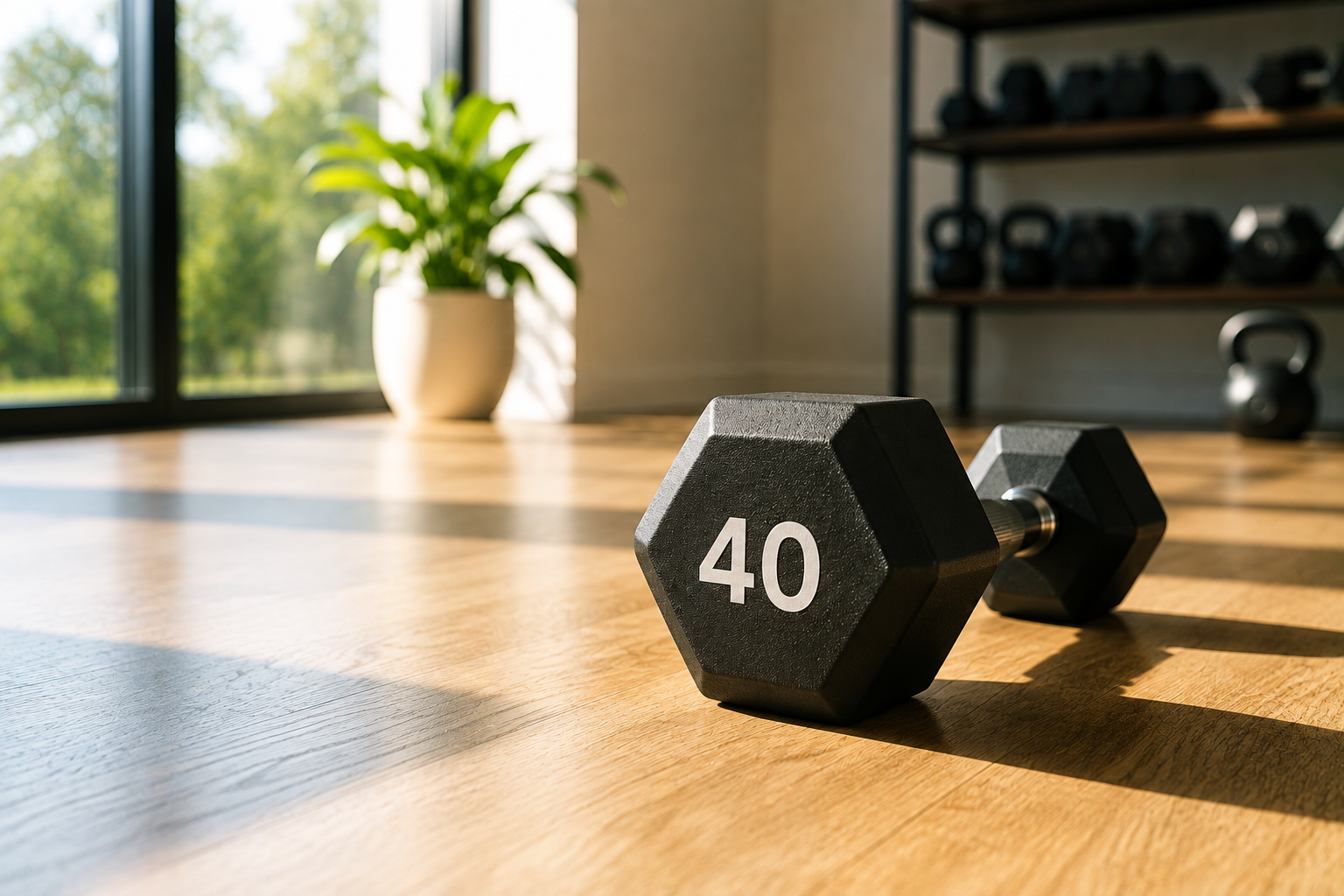
Is Getting Stronger After 40 a Lost Cause?
There is a persistent idea that strength has an expiration date.
You hit 40.
Recovery slows down.
Muscle becomes harder to build.
Joints start complaining.
And suddenly the best years of getting stronger are supposedly behind you.
That's an unnecessarily pessimistic interpretation of aging.
Forty isn't a biological cliff.
What changes is the margin for error.
The training strategy that worked when you were 25 may not be the strategy that works best when you're 45, 55, or 65. But the underlying ability to adapt to resistance training doesn't simply disappear.
In fact, maintaining and developing strength becomes arguably more important as you get older.
The Real Enemy Isn't Age. It's Inactivity.
Aging is associated with changes in muscle mass, strength, power, recovery, and physical function.
But those changes don't happen exclusively because the calendar advances.
Physical inactivity is a major contributor.
This distinction matters because it means that some decline is modifiable.
Resistance training provides a stimulus that tells the body:
This muscle is still needed.
The body can respond by maintaining or increasing muscle size and strength, improving neuromuscular coordination, and making everyday movements easier.
That last point is particularly important.
Strength isn't merely about adding plates to a bar.
It's about being able to:
- stand up from a chair;
- carry groceries;
- climb stairs;
- lift objects from the floor;
- maintain balance;
- get up after a fall;
- remain independent.
The strongest reason to train after 40 may therefore have very little to do with looking muscular.
Strength is an investment in physical independence.
You Can Still Progress
One of the most important concepts for anyone starting or continuing strength training later in life is progressive overload.
The body adapts to a training stimulus.
Once that stimulus becomes easier, you gradually increase the challenge.
That doesn't necessarily mean adding weight every workout.
Progress can mean:
- lifting slightly more;
- performing additional repetitions;
- improving technique;
- increasing range of motion;
- adding a set;
- controlling the eccentric portion;
- reducing unnecessary rest;
- performing the same workload with less perceived effort.
The objective is continued adaptation, not constant punishment.
But Recovery Starts Matter More
This is where the approach may need to change.
A younger lifter might occasionally get away with poor sleep, aggressive training, and questionable technique.
That doesn't mean it was optimal.
It means the consequences may have been easier to tolerate.
As recovery capacity changes, training becomes more dependent on managing fatigue intelligently.
That means paying attention to:
Training volume.
More isn't automatically better.
Intensity.
Heavy training can remain useful, but it needs to be appropriately programmed.
Sleep.
Recovery isn't something that happens after training; it is part of the training process.
Rest days.
Taking a recovery day isn't evidence that you're losing motivation.
Pain.
Normal training discomfort and persistent or worsening pain are not the same thing.
The objective is to accumulate productive training without accumulating so much fatigue that training quality collapses.
Protein Becomes Particularly Important
Nutrition matters at every age, but adequate protein becomes increasingly relevant as people get older.
Older muscle can become less responsive to a given dose of protein and exercise stimulus—a phenomenon often discussed as anabolic resistance.
That doesn't mean older adults need extreme protein intake.
It means consistently eating enough protein and distributing it across meals can help support muscle maintenance and growth when combined with resistance training.
The exact appropriate intake depends on factors such as body size, total diet, training, age, and health status.
The original article's blanket recommendation of 1.2–2.0 g/kg/day should therefore be treated as a broad range rather than a universal prescription.
Don't Turn Every Workout Into a Test of Maximum Strength
There's another trap waiting for people who want to prove that they're "still strong."
They turn every workout into a competition with their younger selves.
That's usually a mistake.
You don't need to constantly test your one-repetition maximum to make progress.
For many people over 40, a better objective is:
Train hard enough to stimulate adaptation while leaving enough capacity to train again.
That can mean working with challenging but controlled loads, maintaining good technique, and progressing gradually.
Strength is built over months and years.
There's little benefit in winning Tuesday's workout if it compromises the next two weeks.
Functional Strength Has a Bigger Payoff
As people age, the usefulness of an exercise becomes increasingly important.
A well-designed program doesn't need to be complicated.
It can include movements that develop:
- pushing strength;
- pulling strength;
- squatting;
- hinging;
- carrying;
- single-leg stability;
- trunk control.
You don't need to perform every variation.
You need a program that trains the major movement patterns and can be progressed consistently.
That could involve barbells, dumbbells, machines, kettlebells, resistance bands, or bodyweight exercises.
The equipment is secondary to the stimulus.
Mobility and Strength Aren't Opposites
Another misconception is that older lifters should choose between strength and mobility.
They shouldn't.
Strength training performed through an appropriate range of motion can itself contribute to functional capacity. Mobility work can complement that training where restrictions actually exist.
The key is not turning the warm-up into an hour-long flexibility session while neglecting strength.
Nor is it loading movements aggressively through ranges you cannot control.
Develop the ability to control the range you have, then gradually expand your capacity where appropriate.
The Biggest Advantage You Have After 40
There is one advantage older lifters can have that beginners often overlook:
experience.
You know more about your body.
You have a better understanding of what a productive workout feels like.
You can recognize when you're tired.
You can plan around work and family obligations.
And you can stop treating every missed workout as a catastrophe.
That makes consistency easier to build if you stop chasing the fantasy of perfect training.
The person who trains intelligently for the next ten years will almost certainly get better results than the person who trains recklessly for six months and spends the next six recovering.
Editorial Synthesis
Where the Argument Is Strong
- Strength training remains highly valuable after 40.
- Maintaining muscle and strength becomes increasingly important for physical function and independence.
- Progressive resistance remains the fundamental training stimulus.
- Adequate nutrition, particularly protein, supports adaptation.
- Recovery and injury management become increasingly important.
Where the Nuance Matters
The idea that people over 40 should simply "train lighter" is too simplistic.
Older adults can still perform challenging resistance training.
The question is how much stress produces a useful adaptation without creating disproportionate fatigue or injury risk.
That answer varies considerably between individuals.
A 42-year-old who has trained consistently for 20 years isn't in the same situation as a sedentary 42-year-old starting resistance training.
Neither is comparable to a 70-year-old with multiple health conditions.
Age matters.
But training history, health, recovery, and individual capacity matter too.
Why This Matters
The question shouldn't be:
"Am I too old to get stronger?"
A better question is:
"How should I train now so I can keep getting stronger for years?"
That's a fundamentally different mindset.
After 40, strength training isn't a futile attempt to recreate your twenties.
It's a way of preserving—and potentially expanding—your physical capabilities while the cost of losing them becomes higher.
You may need more patience.
You may need better recovery.
You may need smarter exercise selection.
You may need to take nutrition more seriously.
But none of those things mean the door to progress has closed.