Opening Question
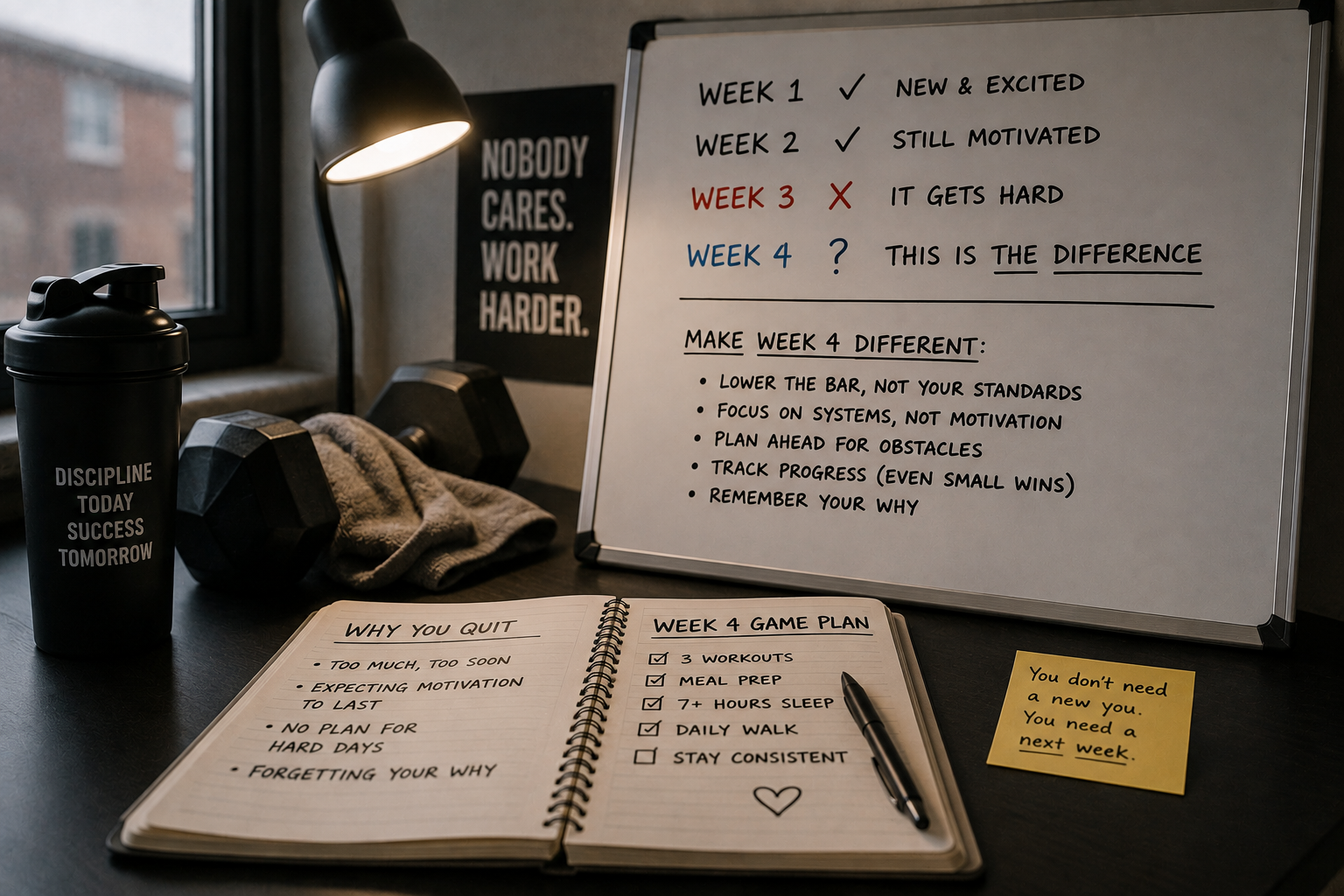
Why do so many people abandon their fitness goals during Week Three?
The first few workouts are fueled by excitement and motivation. But by the third week, that initial enthusiasm often disappears while meaningful physical results are still difficult to see. It's the moment when many people begin questioning whether the effort is worth it.
Understanding why this happens is the first step toward making Week Four the beginning of long-term consistency instead of the end of another failed routine.
Why This Matters Now
Building lasting fitness habits has never been more challenging.
Busy schedules, endless fitness trends, and unrealistic expectations make consistency harder than ever. While starting a workout program is relatively easy, staying committed after the initial excitement fades is where most people struggle.
The good news is that Week Three isn't a sign of failure—it's a predictable stage in the habit-building process.
Expert Perspectives
James Clear: Habits Beat Motivation
James Clear, author of Atomic Habits, believes most people quit because motivation naturally fades before habits become automatic.
Rather than relying on willpower, he recommends making new behaviors almost impossible to avoid.
One of his most well-known strategies is the Two-Minute Rule.
Instead of committing to an hour-long workout every day, begin with something that takes only two minutes—stretching, bodyweight squats, or putting on your training shoes. Starting small lowers resistance while reinforcing consistency.
Clear also emphasizes the importance of identity.
Rather than saying, "I'm trying to work out," adopt the mindset of "I'm someone who trains regularly." When behavior becomes part of your identity, consistency becomes much easier to maintain.
Dr. Greg Wells: Recovery Drives Consistency
Physiologist Dr. Greg Wells explains that Week Three often coincides with accumulated fatigue.
Many beginners expect visible changes almost immediately. When those changes don't appear, motivation drops.
At the same time, many people unknowingly increase training volume too quickly without allowing adequate recovery.
Wells recommends setting smaller milestones instead of chasing dramatic transformations.
Equally important is prioritizing recovery through quality sleep, stress management, and rest days.
Recovery isn't taking time away from progress—it allows progress to happen.
Amanda Cookies: Energy Determines Adherence
Registered dietitian Amanda Cookies highlights another common reason people quit: inadequate nutrition.
Poor food choices often leave people feeling tired, hungry, and discouraged, making workouts feel harder than they should.
She recommends focusing on sustainable eating habits rather than restrictive diets.
Simple strategies like meal preparation, balanced meals containing carbohydrates and protein, and keeping healthy snacks available can make consistency significantly easier.
Amanda also encourages mindful eating over perfection.
Instead of labeling foods as "good" or "bad," building balanced eating habits reduces stress and makes long-term adherence more realistic.
Editorial Synthesis
Where Experts Agree
Although they approach the problem differently, the experts share several common conclusions.
They agree that:
- Consistency matters more than perfection.
- Small, gradual improvements outperform drastic changes.
- Sustainable habits are more effective than relying on motivation.
- Recovery, nutrition, and mindset all contribute to long-term success.
Where Experts Disagree
Their main differences lie in where they place the greatest emphasis.
James Clear focuses on habit formation and identity.
Dr. Greg Wells prioritizes realistic expectations and physical recovery.
Amanda Cookies argues that maintaining energy through proper nutrition is often the deciding factor in whether someone continues training.
Rather than contradicting each other, these perspectives complement one another.
How to Make Week Four Different
If Week Three is where most people quit, Week Four is where successful habits begin to take shape.
Instead of chasing perfect workouts, focus on consistency.
Reduce the pressure to perform at your best every session.
Prioritize recovery as seriously as training.
Fuel your body well enough to support your workouts.
Most importantly, continue showing up—even on days when motivation is absent.
Progress is rarely determined by one exceptional workout.
It's built through dozens of ordinary sessions completed over time.
Why This Matters
Week Three isn't proof that your program isn't working—it's proof that you're transitioning from excitement to discipline.
Everyone experiences the point where motivation fades. The people who succeed aren't necessarily more motivated—they simply have systems that carry them forward when motivation disappears.
By combining James Clear's habit-building strategies, Dr. Greg Wells' emphasis on recovery, and Amanda Cookies' practical nutrition advice, you create a foundation that extends far beyond a single month of training.
Week Four doesn't require a fresh start.