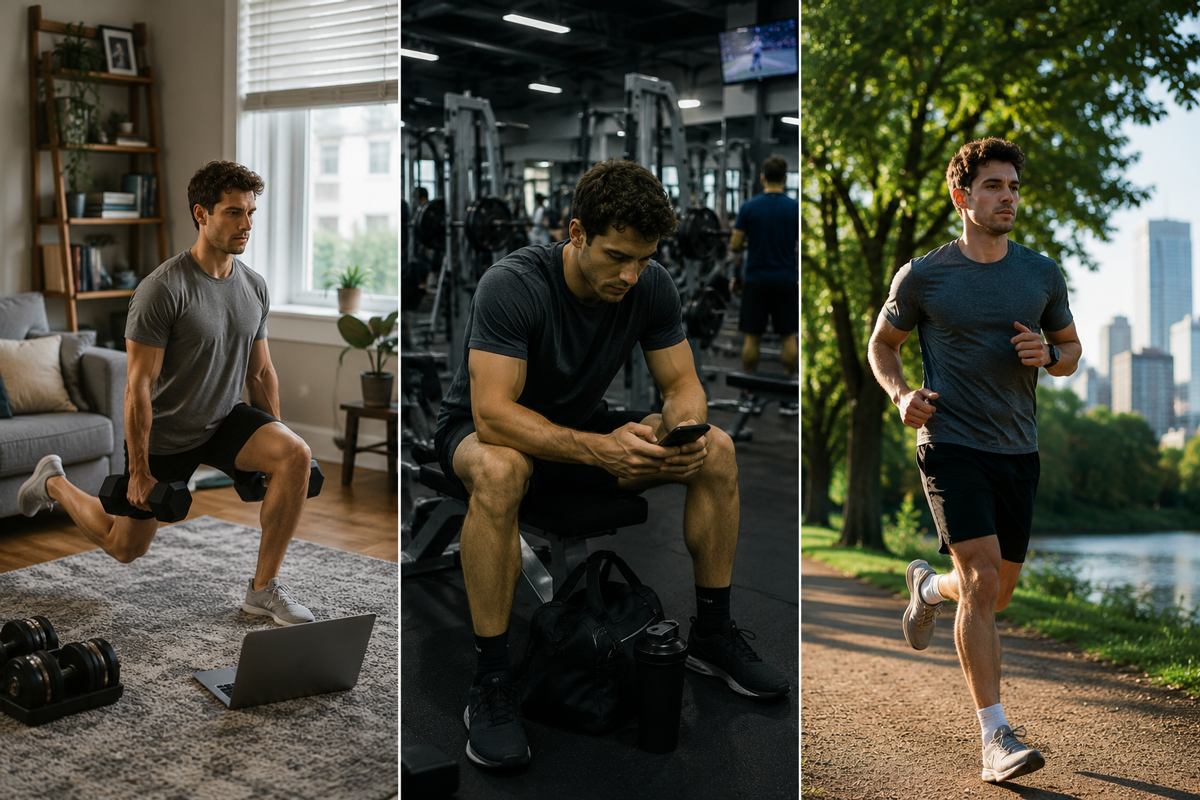
Opening Question
Does where you train matter as much as how you train?
For many people, choosing between working out at home, joining a gym, or exercising outdoors isn't simply a matter of convenience. Each environment influences motivation, consistency, exercise selection, and even recovery.
The question isn't which setting is objectively best—but which one best supports your long-term goals.
Why This Matters Now
Fitness has become more flexible than ever.
The rise of home workout equipment, digital coaching, outdoor fitness communities, and traditional gyms means people have more choices than previous generations.
Yet with more options comes greater uncertainty.
Some believe a fully equipped gym is essential for progress, while others argue that consistency matters far more than access to expensive equipment.
Understanding the strengths and limitations of each training environment can help individuals build routines they are more likely to maintain over time.
Expert Perspectives
Jill Castle: Your Environment Influences More Than Exercise
Pediatric dietitian Jill Castle emphasizes that a training environment affects more than physical activity—it can also shape eating habits and recovery behaviors.
Training at home often provides immediate access to planned meals and healthier food options, making it easier for some individuals to stay consistent with nutrition.
By contrast, gyms offer a structured atmosphere that minimizes household distractions and creates a stronger separation between exercise and daily responsibilities.
Outdoor workouts, while enjoyable and mentally refreshing, may also encourage spontaneous food choices after training, depending on the surrounding environment.
From Castle's perspective, fitness success depends on considering both movement and nutrition as part of the same lifestyle.
Brad Schoenfeld: Consistency Drives Results
Fitness researcher Dr. Brad Schoenfeld approaches the discussion from an evidence-based perspective.
According to Schoenfeld, no environment possesses a monopoly on effective training.
Instead, the determining factor is whether an individual can consistently apply progressive overload over time.
He notes that gyms provide the widest variety of equipment, making them particularly effective for strength development and muscle growth.
However, home workouts can produce excellent results when resistance training is properly structured using bodyweight exercises, resistance bands, adjustable dumbbells, or other available equipment.
Outdoor training introduces unique challenges through hills, uneven terrain, and functional movement patterns that can improve overall athleticism.
Ultimately, Schoenfeld argues that the most effective environment is the one that supports long-term consistency.
Daniel Lieberman: Humans Were Built to Move Outdoors
Evolutionary biologist Dr. Daniel Lieberman examines exercise through the lens of human evolution.
He argues that humans evolved to spend much of their time moving outdoors rather than inside climate-controlled environments.
Natural settings can positively influence:
- Mood
- Motivation
- Stress reduction
- Mental recovery
- Long-term exercise adherence
At the same time, Lieberman recognizes that modern life introduces practical considerations.
Home workouts provide unmatched convenience, particularly for busy professionals and parents.
Gyms offer structured routines, coaching opportunities, and social interaction that many people find motivating.
His conclusion is that successful exercise programs often combine biological preferences with modern practicality.
Editorial Synthesis
Where Experts Agree
Despite emphasizing different aspects of fitness, the experts share several conclusions.
They agree that:
- Consistency remains the strongest predictor of long-term success.
- Training environments influence motivation and behavior.
- Nutrition and recovery should be considered alongside exercise.
- No single environment guarantees better results.
Where Experts Disagree
The differences lie primarily in emphasis.
Castle focuses on how surroundings influence eating habits and daily routines.
Schoenfeld prioritizes training quality and progressive overload regardless of location.
Lieberman highlights the psychological and evolutionary benefits of spending time exercising outdoors.
Each expert values different aspects of the training experience while acknowledging that multiple approaches can succeed.
Comparing the Three Environments
Home Training
Advantages include:
- Maximum convenience
- No commuting time
- Flexible scheduling
- Lower long-term costs
- Greater privacy
Potential challenges include:
- Limited equipment
- Household distractions
- Reduced accountability
- Greater reliance on self-discipline
Gym Training
Advantages include:
- Extensive equipment
- Progressive overload opportunities
- Professional coaching
- Structured environment
- Social motivation
Potential challenges include:
- Membership costs
- Travel time
- Crowded facilities
- Intimidation for beginners
Outdoor Training
Advantages include:
- Improved mental well-being
- Exposure to fresh air and sunlight
- Functional movement patterns
- Greater variety
- Low financial cost
Potential challenges include:
- Weather dependence
- Limited resistance equipment
- Safety considerations
- Less suitability for certain strength-training goals
Choosing the Right Environment
Rather than searching for the "perfect" setting, individuals should ask practical questions:
- Which environment makes it easiest to stay consistent?
- Which fits my schedule?
- Which supports my specific fitness goals?
- Where do I genuinely enjoy exercising?
- Which barriers am I most likely to overcome?
The answers often matter more than whether one environment is theoretically superior.
Many successful exercisers even combine multiple settings—for example, strength training in a gym while walking, cycling, or running outdoors.
Why This Matters
Fitness is ultimately built through repeated behaviors, not perfect conditions.
The environment can influence motivation, nutrition, recovery, and exercise selection, but none of these factors outweigh consistent effort applied over time.
Whether you train in a commercial gym, a spare bedroom, a neighborhood park, or a mountain trail, progress depends on maintaining a routine that matches both your goals and your lifestyle.